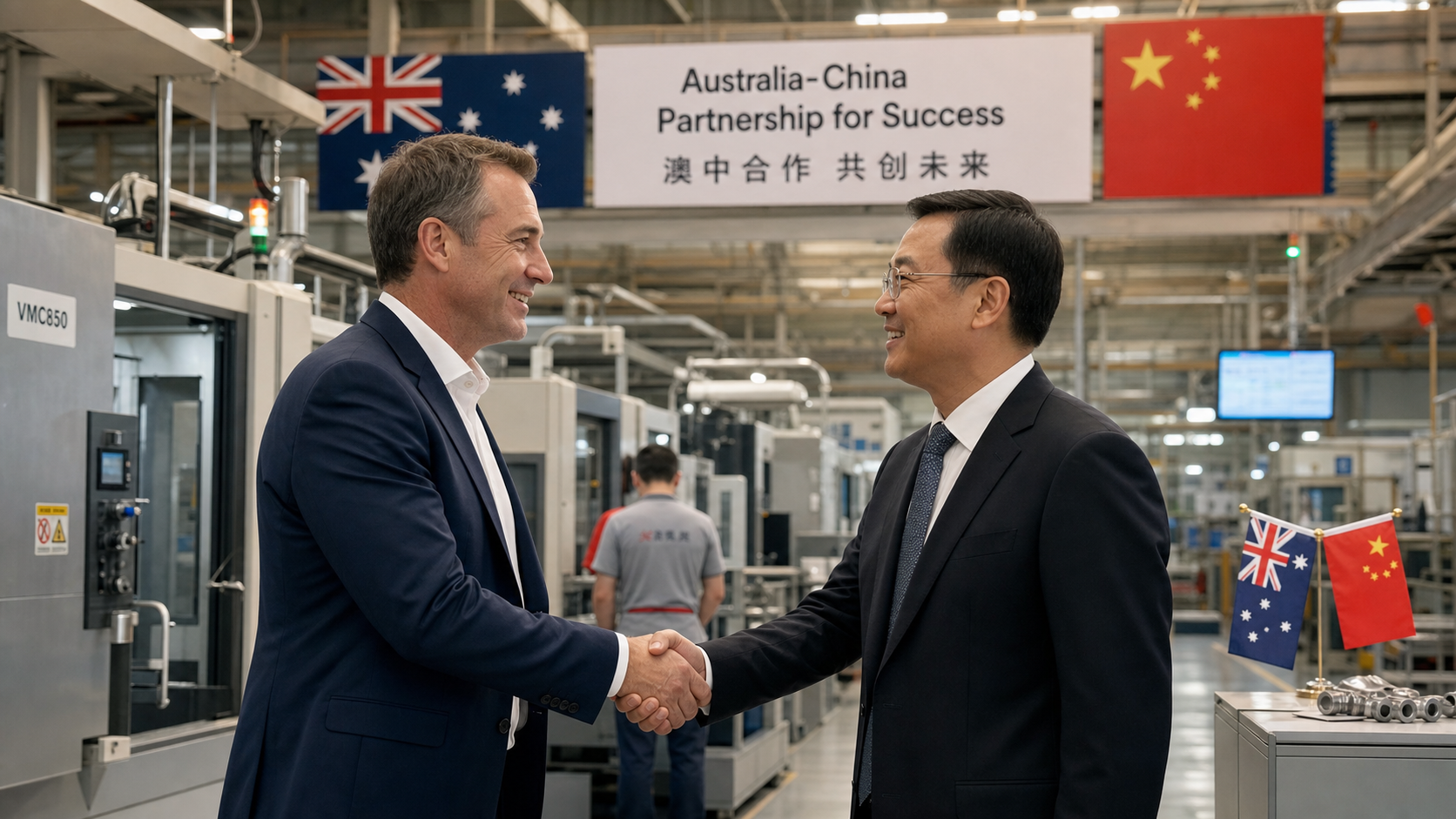
- What is a China sourcing agent?
- Why Australian businesses need one
- How China sourcing works step by step
- Finding and verifying Chinese suppliers
- Negotiating with Chinese manufacturers
- Pre-shipment inspection
- Shipping from China to Australia
- ChAFTA and import duties
- Which industries source from China
- How Sino Partners can help
What is a China Sourcing Agent?
A China sourcing agent is a professional intermediary who represents Australian businesses in China, finding and vetting Chinese manufacturers, negotiating contracts in Mandarin, conducting quality inspections and managing export logistics on behalf of importers who lack the language, relationships or on-the-ground presence to do it themselves.
Unlike a trading company (which buys from factories and resells to you at a margin), a sourcing agent works exclusively in your interest. You deal directly with the manufacturer; the agent ensures you get the right factory, the right price, and the right product.
For Australian businesses, a qualified China sourcing agent bridges four critical gaps: language, culture, geography and verification. China has over 800,000 registered manufacturers. Identifying the right one, confirming they are who they say they are, and managing the relationship in a way that produces consistent results requires expertise that most Australian importers simply do not have in-house.
Why Australian Businesses Need a China Sourcing Agent in 2026
Australia imported US$75.7 billion of goods from China in 2024, making China the single largest source of Australian imports at 25.9% of total import volume. Chinese manufactured goods to Australia grew 39% between 2019 and 2023, driven by machinery, equipment, electric vehicles, medical devices and energy infrastructure.
The opportunity is enormous. But the risks of sourcing without proper representation are equally significant:
- Supplier fraud: Trading companies posing as manufacturers, fake certifications, and deposit scams are well-documented risks for Australian importers using online platforms without verification.
- Quality failures after payment: Without pre-shipment inspection, defects are only discovered on arrival in Australia, at which point recourse against a Chinese supplier is expensive and slow.
- Compliance failures: Products that do not meet Australian Standards, TGA requirements, workplace safety codes or biosecurity rules can be seized at the border or create serious legal liability.
- Overpaying: Prices quoted in English to overseas buyers are routinely 20 to 40% higher than prices negotiated in Mandarin with verified purchase intent.
- Logistics errors: Incorrect HS codes, missing ChAFTA documentation, biosecurity failures and incorrect commercial invoices cause costly customs delays.
The core value of a China sourcing agent is risk reduction. For every dollar spent on professional sourcing support, experienced Australian importers typically save three to five dollars in defect costs, overpayment, delays and compliance failures.
How China Sourcing Works: Step by Step
A professional China sourcing engagement for an Australian business follows a structured process. Understanding each stage helps you evaluate sourcing agents and set realistic expectations.
- Requirements brief: Define exactly what you need, product specifications, quantity, target price, required certifications (Australian Standards, CE, TGA), delivery timeline and packaging requirements.
- Supplier identification: Your sourcing agent searches their verified factory network, industry databases and trade fair contacts to identify 5 to 10 candidate manufacturers. Online platforms like Alibaba are used only as a starting point, not as verification.
- Supplier verification: Each candidate is screened against Chinese business registries, export licence databases and production capacity evidence. Site visits or virtual factory audits confirm they are genuine manufacturers with relevant capability.
- RFQ and shortlisting: A Request for Quotation is sent in Mandarin to shortlisted suppliers. Responses are evaluated on price, lead time, minimum order quantity, certifications and export experience. 3 to 5 suppliers are shortlisted for further engagement.
- Sample round: Samples are ordered from the top 2 to 3 shortlisted suppliers and shipped to Australia for evaluation against your specifications. Feedback is communicated in Mandarin for revision.
- Negotiation and contract: Final supplier selected. Price, payment terms (typically 30% deposit / 70% pre-shipment), delivery schedule, warranty, IP provisions and quality standards are negotiated in Mandarin and documented in a bilingual contract.
- Production monitoring: For larger orders, production milestone checks confirm the order is on schedule and materials are correct.
- Pre-shipment inspection: Independent inspection at the Chinese factory before goods are packed. Quantity, dimensions, quality, labelling and packaging are verified against specification. Non-conformances are documented and remediated before sign-off.
- Export documentation: Commercial invoice, packing list, bill of lading, certificate of origin (for ChAFTA), any required compliance certificates (TGA, ERAC, DAFF) and customs declarations are prepared and verified.
- Shipping and clearance: Freight forwarding arranged (sea or air depending on volume and urgency). Australian customs lodgement, biosecurity clearance and delivery to your warehouse managed.
Finding and Verifying Chinese Suppliers: What Actually Works
The most common mistake Australian importers make is treating Alibaba as a supplier verification tool. It is a marketing platform. Listings are created by businesses that range from genuine factories to multi-brand trading companies to outright fraudulent operations. Product ratings, "Gold Supplier" badges and transaction counts provide almost no reliable verification of manufacturing capability.
Verified supplier identification requires:
- Chinese business registry check (SAMR/AIC): Confirms the entity is legally registered, its registered capital, registered address and business scope.
- Export licence verification: Confirms the supplier has a valid export licence for the product category. Not all Chinese manufacturers are licensed to export.
- Factory visit or third-party audit: Physical inspection of production facilities, equipment, workforce size and quality control processes. Cannot be replicated by video call.
- Reference checks with existing overseas buyers: Speaking to Australian or international importers who have completed successful orders with the factory.
- Certification verification: For products requiring CE, ISO, TGA or Australian Standards compliance, original certificates must be verified directly with the issuing body, copies can be forged.
An experienced China sourcing agent like Sino Partners conducts all of these checks before recommending a supplier to an Australian client. We leverage factory relationships built over years, the most reliable verification is a track record of successful orders.
Negotiating With Chinese Manufacturers: What Australian Importers Need to Know
Price negotiation with Chinese manufacturers is fundamentally different from negotiation in Western business culture. Several principles consistently produce better outcomes for Australian importers:
- Negotiate in Mandarin: Factories quote higher in English. A Mandarin-speaking intermediary with purchasing credibility achieves 15 to 35% lower pricing in most categories.
- Demonstrate volume credibility: Chinese manufacturers respond to serious, quantified purchase intent. Vague inquiries receive poor pricing. A sourcing agent who signals genuine purchase authority changes the dynamic entirely.
- Never accept the first price: First quotes from Chinese manufacturers are invariably padded. Counter-offer at 70 to 80% of the initial quote and negotiate from there.
- Anchor on total value, not unit price: Shipping, payment terms, packaging, labelling, warranty and after-sales support all have monetary value. The best deal is often not the lowest unit price.
- Protect your IP in writing: Non-disclosure agreements, tooling ownership clauses and design ownership provisions should be in the contract before samples are made.
Sino Partners' contract negotiation service manages the full commercial negotiation in Mandarin, producing a bilingual contract that protects Australian importers' interests and is enforceable under Chinese law.
Pre-Shipment Inspection: Your Last Line of Defence
Pre-shipment inspection (PSI) is the single most cost-effective risk management measure available to Australian importers. Conducted at the Chinese factory after production and before packing, PSI catches defects, shortfalls and non-compliance while remediation is still possible, and cheap.
A standard pre-shipment inspection covers:
- Quantity check: actual units produced vs. ordered quantity
- Workmanship and finish: visual defects, surface quality, assembly accuracy
- Dimensional verification: key measurements checked against technical drawings
- Functional testing: products operated or tested against specification
- Packaging and labelling: correct markings, barcode accuracy, carton strength
- Compliance markings: CE, RCM, TGA or AS markings present and correct where required
A detailed inspection report with photographs is typically delivered within 24 to 48 hours. If non-conformances are found, the factory is given a remediation deadline before final sign-off is granted. Sino Partners does not release payment authorisation until inspection sign-off is complete. Learn more about our pre-shipment inspection service.
Shipping from China to Australia: Modes, Costs and Timelines
Choosing the right shipping mode significantly affects landed cost and delivery speed. The main options for shipping from China to Australia:
- FCL (Full Container Load) sea freight: Most cost-effective for large volumes. 20ft or 40ft containers from Chinese ports (Shanghai, Ningbo, Guangzhou, Tianjin) to Australian ports (Sydney, Melbourne, Brisbane, Fremantle). Transit time 14 to 25 days. Best for orders above approximately 5 CBM.
- LCL (Less than Container Load) sea freight: Shared container for smaller shipments. Slightly longer transit due to consolidation/deconsolidation. Best for 1 to 5 CBM orders.
- Air freight: 3 to 7 day transit. Significantly higher cost per kg but essential for urgent, high-value or time-sensitive goods. Suited to samples, medical supplies and perishables.
- Express courier (DHL/FedEx/UPS): For samples and small parcels under approximately 50kg.
Sino Partners' shipping and logistics service manages freight booking, export documentation, Australian customs lodgement, biosecurity clearance and delivery to your warehouse, removing the complexity and cost of managing multiple service providers.
ChAFTA: How Australia's Free Trade Agreement With China Reduces Your Import Costs
The China-Australia Free Trade Agreement (ChAFTA), in force since December 2015, has progressively eliminated tariffs on the vast majority of goods imported from China to Australia. By 2025, approximately 95% of Australian imports from China are tariff-free.
To claim ChAFTA preferences, your shipment must include a valid Certificate of Origin (Form F or back-to-back certificate) issued by an authorised Chinese government body. Without this document, standard most-favoured-nation (MFN) tariff rates apply, which for some product categories can be 5% or higher.
Sino Partners ensures all shipments are structured to claim ChAFTA preferences, with correct HS code classification and origin documentation prepared by the Chinese factory before export. For importers bringing in significant volumes, correct ChAFTA documentation can save tens of thousands of dollars annually.
Which Australian Industries Are Sourcing From China in 2026?
Chinese manufacturing now serves virtually every sector of the Australian economy. The highest-volume and fastest-growing categories include:
- Construction and civil equipment: Excavators, cranes, loaders, telehandlers, compaction equipment from SANY, XCMG, Zoomlion, LiuGong
- Mining and resources: Mining trucks, electric underground loaders, drilling equipment, conveyors, forklifts and material handling
- Electric vehicles: BEVs and PHEVs from BYD, MG, Geely, Great Wall, 77.5% of Australian BEV sales from Chinese brands in 2025
- Healthcare and medical devices: Hospital equipment, rehabilitation aids, PPE, diagnostic devices, pharmaceutical APIs
- Aged care: Mobility aids, patient handling systems, care home furniture, monitoring technology
- Agriculture: Tractors, harvesters, irrigation systems, greenhouse technology, food processing equipment
- Waste and recycling: Sorting equipment, compactors, shredders, recycling machinery
- Ports and logistics: Forklifts, reach stackers, port cranes, semi-trailers, shipping containers
- Energy infrastructure: Solar panels, battery storage, transformers, wind tower components, EV charging equipment
Read our detailed analysis: The Rise of Chinese Equipment and Manufacturing Across Every Sector of the Australian Market.
How Sino Partners Helps Australian Businesses Source From China
Sino Partners is a Sydney-based consulting and advisory firm with a Mandarin-speaking team operating across Australia and China. We provide end-to-end China sourcing support for Australian importers in every major industry sector.
Our China sourcing service covers the complete process:
- Supplier identification and factory verification, shortlisting 3 to 5 verified Chinese manufacturers against your requirements
- Communication and contact development, all supplier communication managed in Mandarin
- Product specification and development, translating your requirements into Chinese-language factory specifications
- Contract negotiation, price, payment terms, warranty and IP protected in a bilingual contract
- Pre-shipment inspection, independent quality verification at the Chinese factory
- Shipping and logistics, freight, customs, biosecurity and delivery management
What sets Sino Partners apart is the combination of deep industry expertise across 13 sectors, Mandarin negotiation capability, verified Chinese factory relationships and Australian-based account management. We are not an online platform, we are a professional advisory firm with 100+ years of combined industry experience.
Ready to Start Sourcing From China?
Tell us what you need and we will identify the right Chinese manufacturers for your business. No obligation, just a conversation with our Mandarin-speaking sourcing team.
Talk to a Sourcing ExpertPublished by Sino Partners, Sydney Australia. Last updated June 2026. For sourcing enquiries: info@sinopartners.com.au