A Shift That Has Already Happened
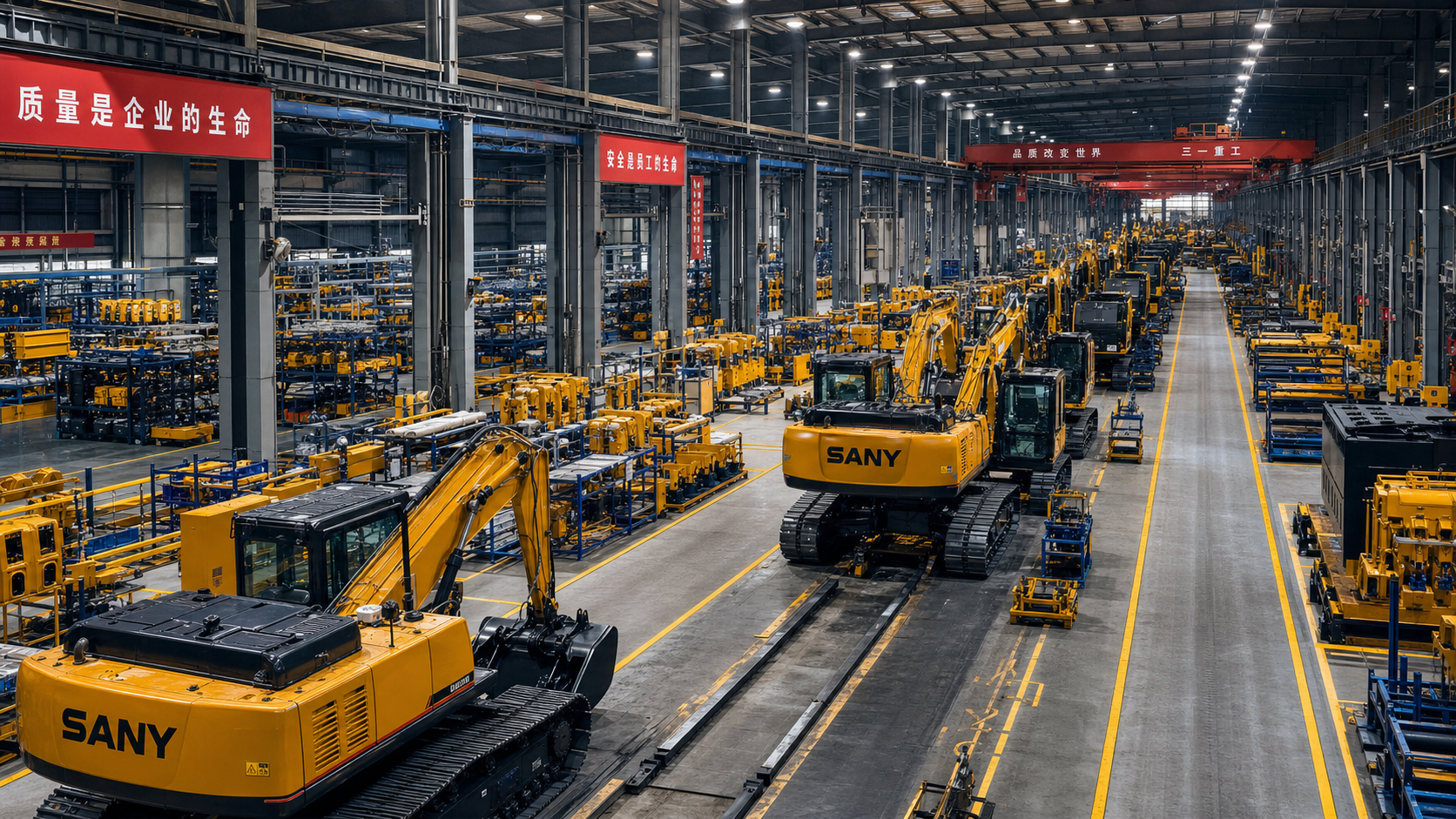
For much of the past two decades, Australian businesses viewed Chinese manufacturing through a single lens: cheap goods, high volume, acceptable quality. That framing is now dangerously out of date. China has become the world's most sophisticated manufacturing economy, producing not just consumer products but precision medical devices, autonomous mining trucks, electric heavy equipment, pharmaceutical APIs, solar and battery infrastructure, and advanced agricultural machinery, all at price points that Western competitors struggle to match.
The numbers are unambiguous. In 2024, Australia imported US$75.7 billion of goods from China, making it the single largest source of Australian imports at 25.9% of total import volume, according to UN COMTRADE data. China's manufactured exports to Australia rose 39% in the three years from 2019-20 to 2022-23 alone, a period during which China was simultaneously imposing punitive trade barriers on Australian agricultural exports. Even as diplomatic tensions ran hot, Australia's appetite for Chinese-made products accelerated.
The structure of those imports has transformed. Machinery and nuclear reactors now represent US$12.68 billion of annual imports from China. Electrical and electronic equipment accounts for a further US$15.74 billion. Vehicles, increasingly electric, have surged from AUD$415 million to AUD$6.2 billion in just four years. This is not a consumer goods story. It is an industrial and capital equipment story, and it is reshaping the cost base, competitiveness and capability of Australian businesses in every major sector.
Sector by Sector: The Future Dependency Map
Construction and Civil Infrastructure
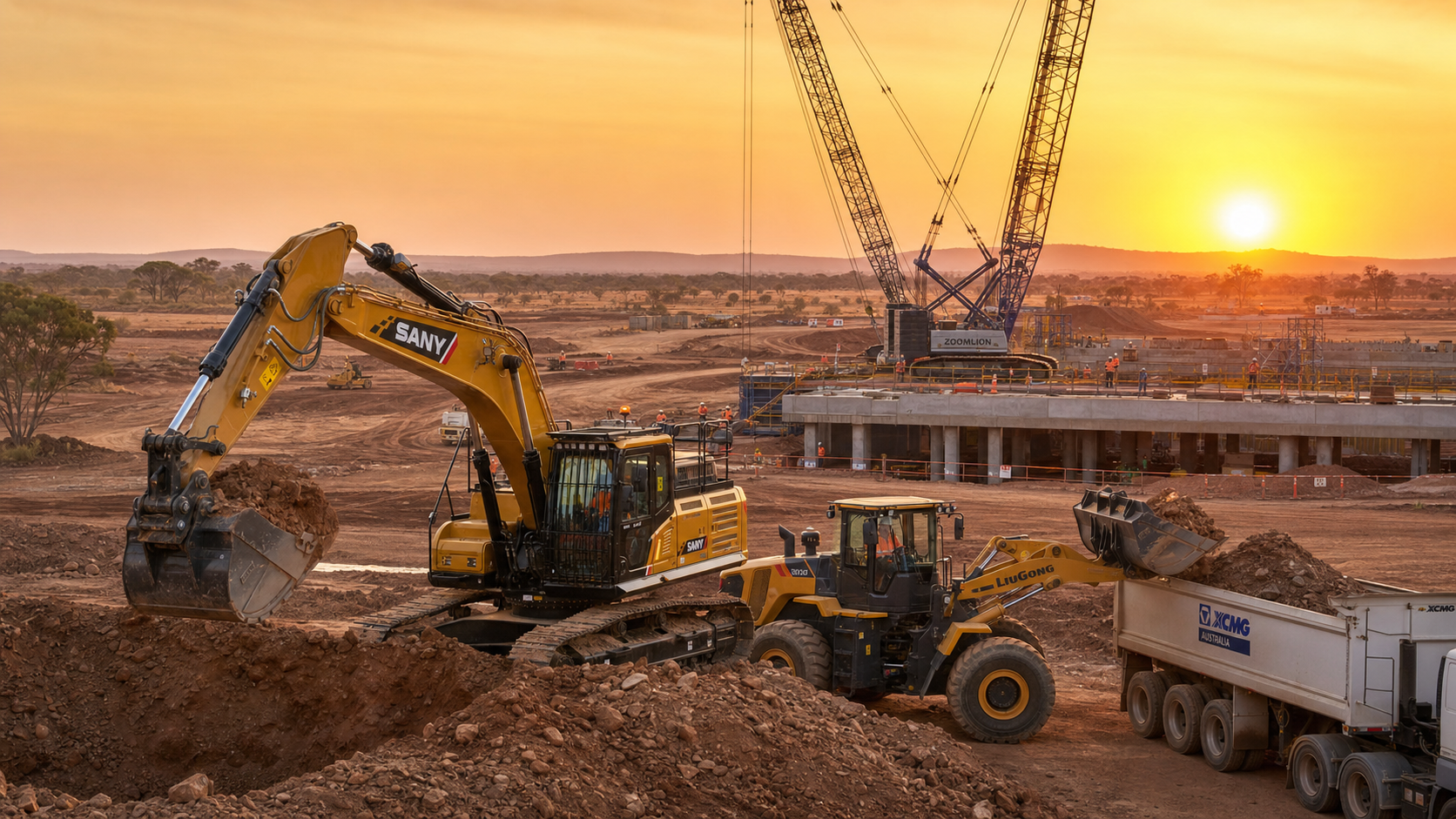
Australia's construction equipment market stood at 24,422 units in 2024 and is projected to reach 27,180 units by 2030 (CAGR of 1.80%). Chinese OEMs, SANY, XCMG, Zoomlion, LiuGong, SDLG, have moved from fringe players to mainstream suppliers across excavators, cranes, loaders, telehandlers and compaction equipment. Imports of Chinese civil engineering equipment grew from AUD$600 million to AUD$1.5 billion in the three years to 2022-23. With Australia's National Housing Accord targeting 1.2 million new homes by 2029, infrastructure pipeline pressure will sustain strong equipment demand. The cost advantage of Chinese-manufactured construction machinery, often 30 to 50% below equivalent European and Japanese models, will make Chinese suppliers the default choice for cost-conscious contractors and fleet operators.
Mining and Resources
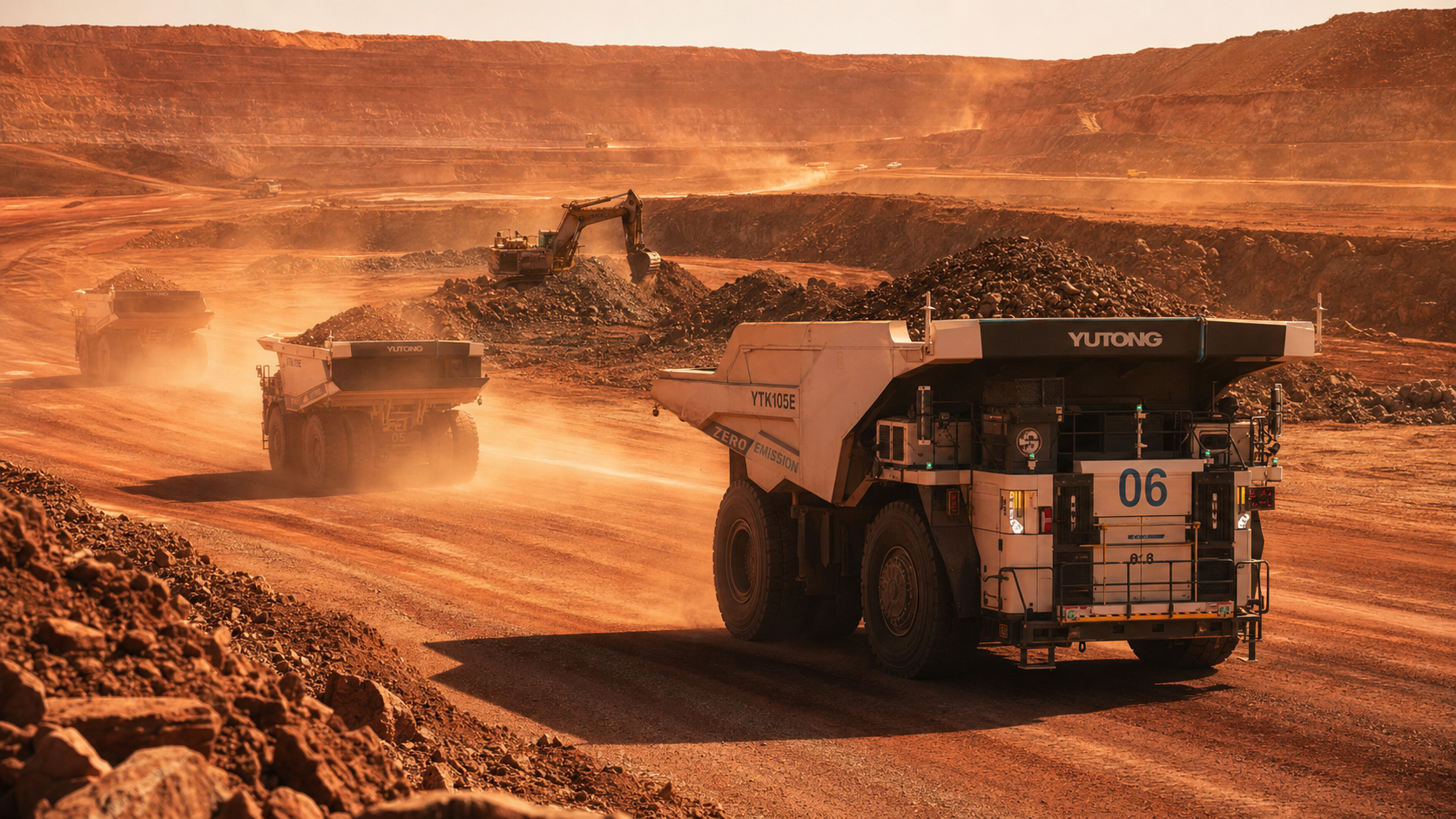
Australia's mining sector is undergoing a profound capital equipment transition. Electric and autonomous mining trucks, battery-electric underground loaders, and smart drilling rigs are becoming operational requirements as miners face Scope 1 emission targets and rising diesel costs. Chinese manufacturers, XCMG, SANY Heavy Industry, Yutong and established OEMs entering the autonomous segment, are developing electric mine truck platforms at scale. Imports of Chinese mechanical handling equipment (forklifts, conveyor systems, material handling) grew 96% over three years to AUD$1.6 billion in 2022-23. Machine tools from China account for 159% share of total Australian machine tool imports by volume, though at lower per-unit values than Italian or German equivalents. As mining automation accelerates and electric fleet mandates tighten, Chinese suppliers of battery systems, electric drivetrains and autonomous vehicle platforms will become central to Australian mining capital procurement.
| Import Category from China | Value (AUD approx.) | 3-Year Growth | Key Chinese Suppliers |
|---|---|---|---|
| Motor Vehicles (incl. EVs) | $6.2B | +1,394% | BYD, SAIC/MG, Great Wall Motors, Geely/Zeekr |
| Electric Machinery | $3.1B | +88% | CATL, BYD Energy, Huawei Digital Power |
| Civil Engineering Equipment | $1.5B | +150% | XCMG, SANY, Zoomlion, LiuGong, SDLG |
| Mechanical Handling Equipment | $1.6B | +96% | Heli, Hangcha, XCMG Forklift, Manitou China |
| Steel Structures (incl. Wind Towers) | $2.3B | +71% | Sinoma, CSSC, DAJIN Wind |
| Trucks and Semi-Trailers | $2.7B+ | +600%+ | SINOTRUK, FAW, Dongfeng, Foton |
| Machinery and Nuclear Reactors (HS84) | $12.68B | +ongoing | Broad range of industrial OEMs |
| Sources: ASPI Strategist 2024, UN COMTRADE 2024, DFAT, ABS International Trade 2023-24, Trading Economics | |||
Electric Vehicles and Energy Infrastructure
The electric vehicle transition is the most visible front of Chinese manufacturing's advance into Australia. In 2025, Chinese brands supplied 77.5% of all battery electric vehicles sold in Australia. BYD alone grew 77.3% year-on-year to 25,287 units, making it Australia's second-largest EV brand. Australia's EV market is projected to grow at a CAGR of 20% from 2026 to 2035, reaching AUD$55.7 billion. By 2035, Chinese-origin brands are forecast to account for 43% of all new vehicle sales in Australia, according to the Australian Automotive Dealer Association.
Beyond passenger vehicles, China dominates the energy infrastructure supply chain. It provides more than 70% of Australia's shipping containers, semi-trailers and steel structures. Solar panels, battery storage systems, electricity transformers, cable and insulating materials, the hardware of Australia's energy transition, are overwhelmingly Chinese-sourced. Chinese electric power machinery imports to Australia grew 60% in three years. Australian businesses in energy, logistics, waste management and agriculture that delay building Chinese sourcing capability will find themselves operating at a structural cost disadvantage.
Healthcare, Medical Devices and Life Sciences
During COVID-19, Australia confronted a painful reality: more than 90% of some pharmaceutical input categories were imported, and a significant proportion originated in China. Rather than triggering a retreat from Chinese sourcing, this has driven a more sophisticated approach. Chinese medical device manufacturers have dramatically improved regulatory compliance capability, with growing numbers achieving TGA recognition and CE marking. Hospital beds, rehabilitation equipment, diagnostic devices, PPE, medical consumables, laboratory instruments and pharmaceutical APIs are all categories where Chinese manufacturers deliver internationally competitive quality at 40 to 70% lower cost than Western equivalents.
Australia's aged care sector, facing a 70% increase in demand by 2050 as the population ages, will be particularly dependent on cost-competitive Chinese-sourced equipment for mobility aids, patient handling systems, monitoring technology and care home fit-outs. Healthcare organisations that develop direct Chinese supplier relationships now will hold a significant procurement advantage through the 2030s.
Agriculture and Food Processing
Chinese agricultural machinery manufacturers, YTO, LOVOL, Changfa, DongFeng Agricultural, have made significant inroads into Australian and New Zealand markets, offering tractors, harvesters and precision agriculture equipment at price points well below established Japanese and European brands. Irrigation systems, greenhouse technology, food processing lines, cold storage equipment and packaging machinery are all high-growth Chinese export categories into Oceania. With Australian farm input costs at record levels and farmer margins under pressure, Chinese equipment offers a structural relief valve that is increasingly hard to ignore.
Waste Management, Ports and Logistics
Mechanical handling imports from China grew 96% in three years to AUD$1.6 billion. Forklifts, reach stackers, port cranes, conveyor systems, waste sorting equipment, compactors and recycling machinery are all dominated by Chinese manufacturers. As Australia scales up its circular economy infrastructure, mandated by state and federal waste targets, the capital equipment will overwhelmingly come from China. Chinese crane and port equipment manufacturers (ZPMC, Sany Port, XCMG) already supply a significant proportion of Australian port handling capacity.
| Sector | Current AU Reliance on China | 2030 Outlook | Key Driver |
|---|---|---|---|
| Construction Equipment | ~30-40% of new fleet additions | 50%+ as price pressure intensifies | Housing Accord, infrastructure pipeline |
| Electric Vehicles | 77.5% of BEV sales (2025) | 43% of all new car sales by 2035 | NVES emissions standards, CAGR 20% |
| Mining Equipment | Growing from low base | Major share of electric/autonomous segment | Scope 1 targets, diesel cost |
| Healthcare Devices | Significant for consumables and aids | Expanding as aged care demand surges | Ageing population, cost pressure |
| Energy Infrastructure | Dominant (solar, battery, transformers) | Increasing with energy transition | Net zero transition, grid investment |
| Ports and Logistics | 70%+ for containers, semi-trailers | Continued dominance | Port expansion, e-commerce growth |
| Agriculture Machinery | Growing market share | Significant as input costs drive value-seeking | Farm margin pressure, precision ag |
| Sources: ASPI 2024, AADA 2025, Expert Market Research 2025, ABS, BloombergNEF, DFAT | |||
"China's annual sales of manufactured goods to Australia rose 39% in three years, while China was simultaneously imposing trade barriers on Australian exports. The structural dependency runs in one direction and it is deepening."ASPI Strategist, March 2024
Why Oceania Businesses Cannot Afford to Source Blind
The case for Chinese sourcing is compelling on price and breadth. But buying from China without local expertise, supplier verification and relationship management is a high-risk strategy. The Australian market is littered with examples of businesses that sourced directly from online platforms, received inferior product, faced certification failures, lost deposits to unverified suppliers, or found themselves with equipment for which no local parts or service support exists.
Successful Chinese sourcing requires five capabilities that most Oceania businesses do not have in-house:
- Factory verification and due diligence, separating genuine manufacturers from trading companies, verifying production capacity and quality systems
- Technical specification translation, ensuring product specifications meet Australian Standards, TGA, EPA and workplace safety requirements
- Commercial negotiation in Chinese, price, payment terms, warranty and exclusivity are all significantly better when negotiated in Mandarin by a trusted intermediary
- Pre-shipment inspection, independent quality verification before goods leave China, when correction is still possible
- Logistics and customs management, navigating Chinese export documentation, Australian biosecurity requirements and duty classifications
The Strategic Imperative for 2026 and Beyond
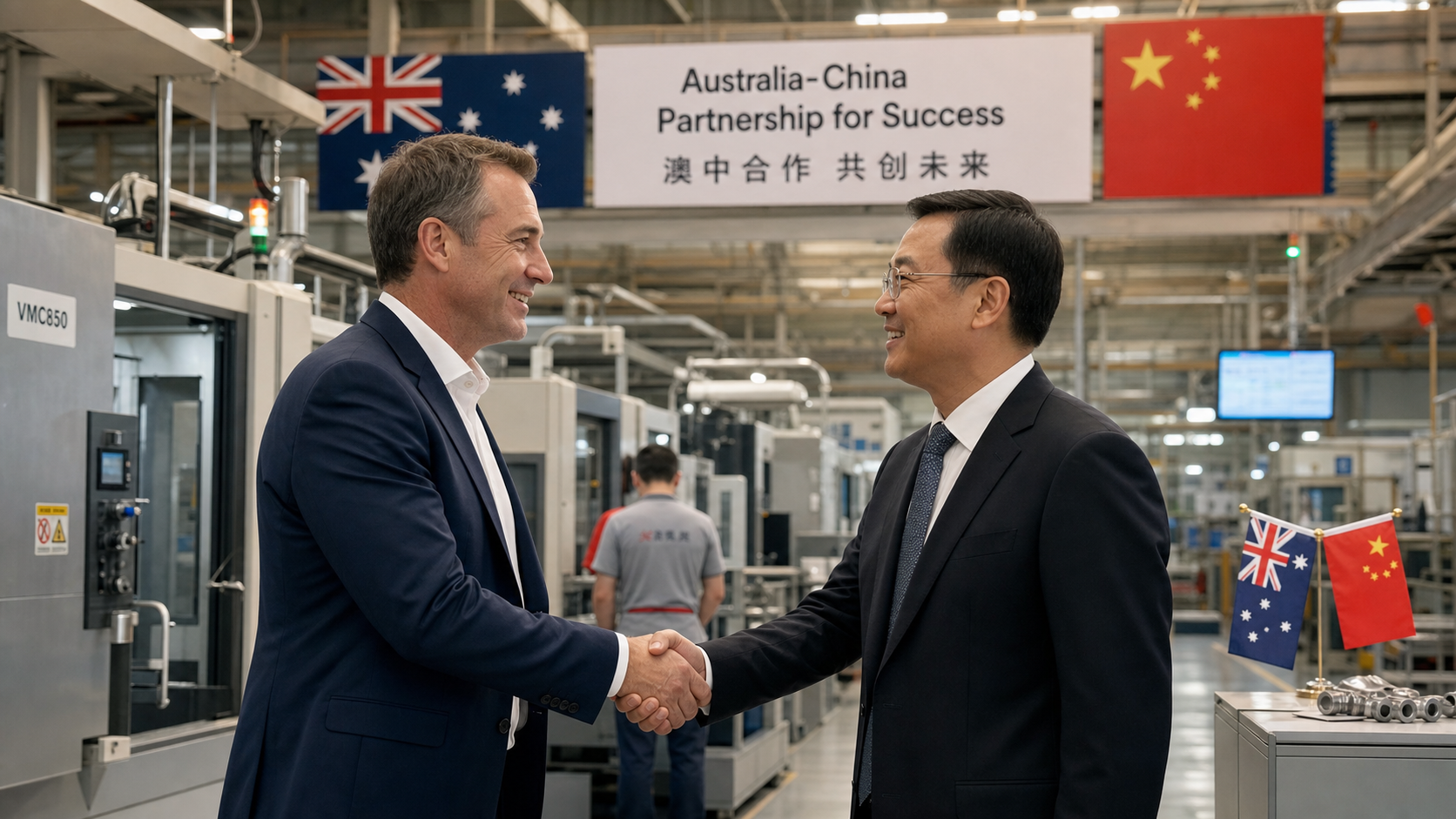
Australia-China bilateral trade reached AUD$308.7 billion in 2024-25, having grown 113% since 2015 despite years of diplomatic friction. China accounts for 33.2% of all Australian goods exports and 25.9% of all imports. This is not a relationship that diversifies away, it is one that deepens, broadens and becomes more technically complex.
For Oceania businesses across construction, mining, agriculture, healthcare, logistics, energy and waste management, the question is no longer whether to source from China. It is how to do it well. Businesses that build verified Chinese supplier networks now, with proper due diligence, compliance checks and relationship infrastructure, will operate at lower cost, with greater supply chain resilience, and with access to technology and product categories that simply do not exist at comparable quality and price from any other manufacturing base.
Those that continue to rely on Western incumbents for capital equipment and manufactured inputs will face a widening cost gap that is structurally difficult to close. The window for building first-mover Chinese supplier relationships in emerging categories, electric heavy equipment, autonomous mining systems, aged care technology, circular economy infrastructure, is now.
Ready to Find the Right Chinese Manufacturer?
Sino Partners provides end-to-end China sourcing support, from supplier identification and factory verification through to contract negotiation, pre-shipment inspection and logistics management. We work across all sectors and speak Mandarin at every stage.
Start a ConversationPublished by Sino Partners, Specialist consulting and advisory bridging China and Oceania. For enquiries contact info@sinopartners.com.au