- Why Australian businesses import machinery from China
- Step 1: Define specifications and compliance requirements
- Step 2: Find a verified Chinese manufacturer
- Step 3: Request for quotation and price negotiation
- Step 4: Sample and prototype approval
- Step 5: Contract and payment terms
- Step 6: Pre-shipment inspection
- Step 7: Shipping options from China to Australia
- Step 8: Australian customs, biosecurity and documentation
- ChAFTA and import duties: how to claim 0% tariff
- Machinery categories, HS codes and duty rates
- How Sino Partners manages this end-to-end
Why Australian Businesses Import Machinery from China
China is the world's largest manufacturer of industrial machinery. For Australian businesses across construction, agriculture, manufacturing, mining, waste management and logistics, importing directly from Chinese factories delivers material advantages that domestic or European procurement cannot match.
The three primary drivers are cost, product range and quality improvement:
- Cost: Equivalent machinery manufactured in China typically costs 30 to 60% less than comparable European or Japanese alternatives, even after freight, duties and compliance modifications. For capital equipment with a 10 to 15 year service life, the total cost of ownership advantage is significant.
- Range: Chinese manufacturers now produce the full spectrum of industrial equipment, from sub-tonne mini excavators to 200-tonne mining trucks, at volumes and lead times that Western manufacturers cannot match. Categories that did not exist in Chinese production a decade ago, such as electric underground mining loaders and hydrogen fuel cell forklifts, are now mass-produced in China.
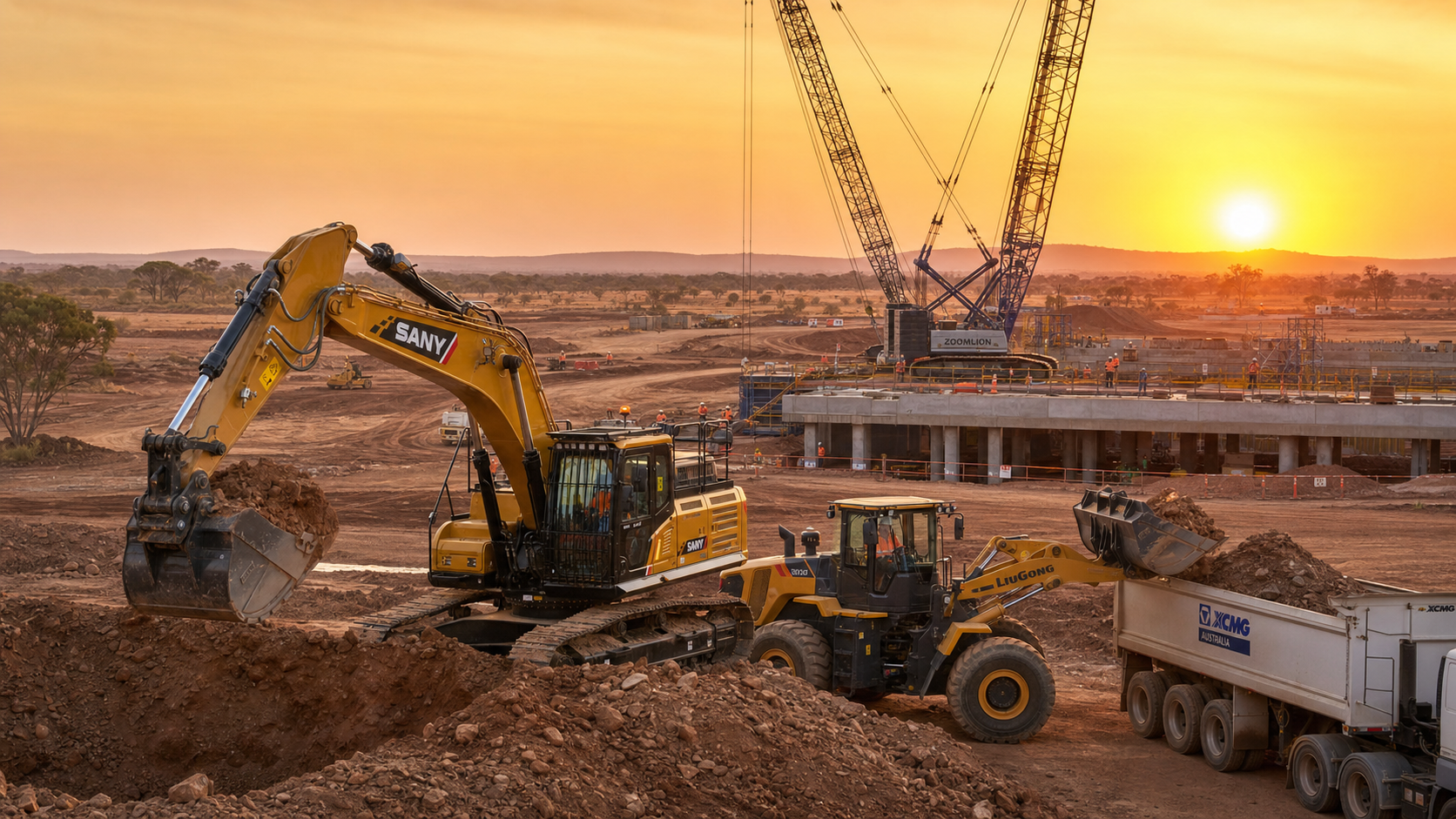
- Quality improvement: The quality trajectory of Chinese industrial machinery has been steep. Major manufacturers such as SANY, XCMG, Zoomlion, HELI, Lonking and Liugong now hold ISO 9001 certification, produce CE-marked equipment for European export, and operate R&D facilities in Germany, Japan and the United States. The quality gap that justified European price premiums in the 2000s has largely closed for the mainstream categories most relevant to Australian importers.
Australia imported over AUD $18 billion in machinery and mechanical appliances from China in the 2023-24 financial year, making it the single largest machinery source country by a substantial margin. The trend is structural, not cyclical.
The risk in machinery imports is not the manufacturer quality. It is the process: finding the right factory, specifying correctly, protecting your interests in the contract, verifying quality before shipment, and navigating Australian compliance requirements. A structured process managed by experienced professionals eliminates most of the risk.
Step 1: Define Your Specifications and Compliance Requirements
The most costly mistakes in machinery imports originate in underspecified requirements briefs. Before approaching any Chinese manufacturer, Australian importers must document precisely what they need, including the compliance obligations that govern the equipment once it arrives in Australia.
Technical Specifications
A complete machinery specification brief should include:
- Functional requirements: what the machine must do, output rates, load ratings, operating environment
- Dimensional and weight constraints: site access, transport permits, storage dimensions
- Power supply: voltage, phase, frequency (Australia uses 230V/50Hz; many Chinese factories default to 380V/50Hz three-phase for industrial equipment)
- Operating conditions: temperature range, dust exposure, humidity, altitude
- Safety features required: guarding specifications, emergency stop locations, operator protection
- Expected service life and maintenance access requirements
- Spare parts and consumable availability in Australia
Australian Compliance Requirements
Machinery entering Australia for commercial use must comply with a range of regulatory frameworks. The applicable requirements depend on the equipment type and industry sector:
- Work Health and Safety (WHS): All plant and machinery used in Australian workplaces must comply with the Work Health and Safety Act 2011 (Cth) and the equivalent state and territory legislation. The WHS Regulations 2017 set specific requirements for plant design registration, item of plant registration, and operator competency for certain categories of plant. Your specification must confirm the machinery will meet these obligations.
- Australian Standards: Key machinery standards include AS 4024 (safeguarding of machinery), AS/NZS 3000 (electrical wiring rules), AS 1210 (pressure vessels), AS 4600 (cold-formed steel), and category-specific standards for cranes (AS 1418), forklifts (AS 2359) and other plant types. Many of these align with or are adapted from ISO and IEC standards that Chinese factories already comply with for European export.
- Electrical compliance: Electrically powered machinery requires an Electrical Equipment Safety System (EESS) declaration of compliance before it can be legally connected and operated in Australia. This applies to most electrically powered industrial equipment.
- EPA and environmental requirements: Diesel-powered equipment must comply with emission standards. Certain equipment categories (spray systems, chemical handling plant, noise-emitting equipment) may require EPA approval in some states.
- Design registration: High-risk plant designs (cranes, hoists, pressure vessels, scaffolding, certain lifting attachments) must have the design registered with the relevant state WHS regulator before being manufactured or imported. Verify whether your specific equipment category requires design registration before placing an order.
Preparing a complete compliance checklist before approaching manufacturers ensures that your RFQ specifies exactly what certification and documentation the factory must provide, and prevents the common problem of receiving machinery that cannot legally be operated in Australia without expensive retrofit.
Step 2: Find a Verified Chinese Manufacturer
Finding a verified Chinese machinery manufacturer requires more rigour than consumer goods sourcing. Machinery is high-value, difficult to return, and potentially dangerous if produced by a factory without genuine engineering capability.
Why Alibaba Is Not a Verification Tool
Alibaba and similar B2B platforms are marketing channels. Machinery listings are created by businesses ranging from genuine OEM factories to trading companies reselling other factories' products to opportunistic resellers with no manufacturing capability. "Gold Supplier" and "Verified Supplier" badges on these platforms are paid tiers, not quality certifications. For machinery procurement, using Alibaba as the sole discovery and verification method is a material risk.
Factory Verification Process
Verified Chinese machinery manufacturer identification involves several independent checks:
- Chinese business registry (SAMR) verification: Confirms the entity is legally registered, its registered business scope includes machinery manufacture, its registered capital, and its registered address matches the claimed factory location.
- Export licence check: Confirms the factory holds a valid export licence for the relevant machinery category. Chinese manufacturers without export licences cannot legally export directly.
- Factory audit: A physical site visit or certified third-party audit verifies that manufacturing infrastructure, equipment, workforce and quality systems match the factory's claimed capabilities. Key indicators include: CNC machining capacity, welding certification, paint line quality, incoming materials inspection process, and finished goods testing facilities.
- Certification verification: ISO 9001, CE marking, and any Australian Standards compliance certificates must be verified directly with the issuing certification body. Certificate forgery is common; never rely on a copy provided by the supplier without independent verification.
- Reference verification: Speaking directly with existing international buyers, preferably in Australia, who have received multiple successful orders from the factory. A factory's track record with similar importers is the most reliable quality indicator available.
Sino Partners maintains a verified network of Chinese machinery manufacturers across all major equipment categories relevant to Australian industry. Our factory verification process includes physical audits, registry checks and export capability assessment before any factory is introduced to a client.
Step 3: Request for Quotation and Price Negotiation in Mandarin
Once shortlisted manufacturers are identified and verified, a Request for Quotation (RFQ) is issued in Mandarin. This is a critical but commonly overlooked step: Chinese factories quote differently to Mandarin-speaking buyers with demonstrated purchase intent than they do to English-language online inquiries.
What the RFQ Should Cover
A well-structured machinery RFQ specifies:
- Full technical specification, referencing applicable Australian Standards
- Required certifications and compliance documentation
- Quantities (initial order and projected annual volume)
- Target delivery timeframe and incoterms (typically FOB or CIF)
- Packaging and shipping mark requirements
- Warranty terms required
- After-sales parts and service expectations for Australia
- Required documentation: commercial invoice, packing list, bill of lading, Certificate of Origin, test certificates, operation manuals in English
Price Negotiation
Machinery price negotiation conducted in Mandarin by an agent with credible purchase authority consistently produces 15 to 35% lower pricing than self-directed English-language negotiation. Chinese manufacturers price their risk: an overseas buyer with an apparent inability to verify quality, enforce contracts or place repeat orders is considered a higher-risk, lower-priority customer. A Mandarin-speaking agent with a verifiable track record of managing international machinery orders changes that dynamic entirely.
Standard negotiation principles for Chinese machinery procurement include: providing detailed specifications that demonstrate technical seriousness, signalling multi-year purchase intent to justify investment in the relationship, negotiating total delivered value rather than unit price alone, and using competing shortlisted quotes to anchor the negotiation.
Step 4: Sample and Prototype Approval
For most machinery categories, a full pre-production sample is not practical given the cost and size of the equipment. Instead, the sample and approval process typically involves:
- Engineering drawing approval: The factory submits CAD drawings and 3D models for review and approval before fabrication begins. Any modifications required by Australian compliance are specified at this stage.
- First article inspection (FAI): For the first unit produced, a detailed first article inspection is conducted at the factory, verifying all dimensions, weld quality, component fitment and safety features against the approved drawings and specifications.
- Physical sample (where applicable): For smaller components, tooling, attachments or sub-assemblies, physical samples are shipped to Australia for evaluation. This is standard for safety-critical components such as load chains, hooks, wire ropes and hydraulic fittings.
- Functional test at factory: Before shipment, the completed machine is run under load at the factory. Test results, including load test certificates for lifting equipment, are documented and provided with the shipment.
Any identified non-conformances are communicated in Mandarin with clear remediation instructions and a re-inspection requirement. Approval to proceed to production is only granted after all specifications are confirmed.
Step 5: Contract and Payment Terms
A machinery import contract between an Australian buyer and a Chinese manufacturer requires careful drafting in both English and Mandarin to be practically enforceable. The contract should be negotiated before any deposit is paid.
Payment Structure: The 30/70 Model
The standard payment structure for Chinese machinery orders is a 30% deposit on order confirmation, with the remaining 70% payable against documents (typically release of the bill of lading or pre-shipment inspection sign-off). Variation from this structure is possible but the 30/70 split is widely understood in Chinese manufacturing and provides reasonable protection to both parties.
Key principles for payment terms:
- Never pay 100% upfront for a first order with a new factory, regardless of the inducement offered
- Tie the 70% balance to pre-shipment inspection approval, not merely factory sign-off
- For large orders (above approximately AUD $500,000), consider a letter of credit (LC) rather than telegraphic transfer (TT), providing a bank-mediated payment mechanism tied to document compliance
- Specify the currency, bank details and any foreign exchange hedging arrangements in writing
Key Contract Provisions
A well-drafted China machinery supply contract covers:
- Specification and technical standards: Incorporated by reference to the approved drawings, specifications and applicable Australian Standards
- Delivery schedule and milestones: With liquidated damages clauses for material delay
- Quality standards and inspection rights: Including the Australian buyer's right to conduct pre-shipment inspection
- Warranty: Duration (12 to 24 months is standard for machinery), coverage (manufacturing defects, not wear items), parts supply obligations and remediation process for warranty claims
- Intellectual property: For bespoke or modified designs, the contract must clearly state that all designs, drawings, tooling and moulds produced for the order are owned by the Australian buyer. A separate non-disclosure agreement (NDA) should be executed before design drawings are shared with any factory.
- Governing law and dispute resolution: Arbitration under China International Economic and Trade Arbitration Commission (CIETAC) rules or the ICC is generally preferable to litigation in Chinese courts for Australian buyers
- Inspection and acceptance: Clear process for accepting or rejecting goods, including remediation timelines and consequences of non-remediation
Sino Partners' bilingual contract templates are specifically designed for Australian machinery importers and have been reviewed against Chinese contract law requirements. Read more about our contract negotiation service.
Step 6: Pre-Shipment Inspection
Pre-shipment inspection (PSI) is the single most important quality control step available to Australian machinery importers. Conducted at the Chinese factory after production is complete and before the machinery is packed for shipping, PSI provides independent verification that what you are paying for is what you are getting.
Why Pre-Shipment Inspection Is Critical for Machinery
Machinery is uniquely difficult to remediate after it arrives in Australia. Unlike consumer goods where a defective batch can be quarantined and credited, heavy machinery problems discovered post-arrival involve: return freight costs that can exceed the original equipment value, lengthy customs and re-export paperwork, loss of production while the issue is resolved, and factory disputes conducted across time zones and language barriers. PSI is not insurance against these problems; it prevents them.
What Machinery Pre-Shipment Inspection Covers
- Quantity and configuration: Units produced versus ordered quantity; correct model variants, attachments and options
- Dimensional verification: Key dimensions checked against approved technical drawings using calibrated measuring instruments
- Structural integrity: Weld quality, plate thickness, frame alignment and structural component fitment
- Mechanical systems: Hydraulic system pressure testing, drivetrain operation, steering and braking function
- Electrical systems: Wiring harness routing and protection, control panel operation, safety interlocks, lighting and instrumentation
- Safety features: Guards and barriers in place and secure, emergency stops functional and correctly labelled, ROPS/FOPS structures present where required
- Paint and finish: Coating thickness measured, surface preparation quality, finish consistency
- Labelling and markings: Serial numbers, capacity plates, CE and other certification markings present and correct; operator manuals included
- Packaging and crating: Export crating adequate for sea freight, desiccants in place, blocking and bracing correct for the shipping mode and transit time
A full inspection report with photographic evidence is typically completed within 24 to 48 hours. Non-conformances are communicated to the factory with a defined remediation deadline. Sino Partners does not authorise the 70% balance payment until pre-shipment inspection sign-off is confirmed. Learn more about our pre-shipment inspection process.
Step 7: Shipping Options from China to Australia
Machinery is predominantly shipped by sea freight due to its weight, size and cost sensitivity. The right shipping mode depends on the volume, weight, urgency and nature of the equipment.
Full Container Load (FCL) Sea Freight
FCL is the most cost-effective option for most machinery imports. A single 20ft or 40ft container is dedicated to your shipment, loaded at the factory (or a nearby freight station) and sealed for direct transit to Australia. Transit times from major Chinese ports to Australian ports:
- Shanghai or Ningbo to Melbourne or Sydney: 18 to 22 days
- Guangzhou (Nansha) or Yantian to Brisbane or Sydney: 14 to 18 days
- Tianjin to Fremantle: 22 to 28 days
A standard 20ft container carries approximately 28 to 30 CBM and up to 25 tonnes payload. A 40ft container carries approximately 67 CBM and up to 28 tonnes. For out-of-gauge machinery (overheight, overwidth or overweight), flat rack or open-top containers are used, with break-bulk shipping reserved for the largest plant items.
Less than Container Load (LCL) Sea Freight
LCL consolidates multiple importers' cargo into a shared container. It is appropriate for shipments below approximately 5 CBM. LCL is slightly longer in total transit due to consolidation and deconsolidation handling, and carries a higher per-CBM rate than FCL. For regular small-volume machinery part orders or attachments, LCL is practical and cost-effective.
Air Freight
Air freight provides 3 to 7 day transit from Chinese cargo hubs (Shanghai Pudong, Guangzhou Baiyun, Beijing Capital) to Australian airports. The cost per kilogram is typically 6 to 10 times higher than sea freight. Air freight is economically justified for: urgent spare parts to prevent production downtime, time-critical first articles or samples, high-value low-weight electronic components, and situations where the cost of delay exceeds the freight premium.
Incoterms and Responsibility
The choice of Incoterms governs where supplier responsibility ends and buyer responsibility begins. For Australian machinery imports:
- FOB (Free On Board): Supplier is responsible to the point the cargo clears the export port rail. The buyer arranges and pays for international freight, insurance and Australian customs. FOB gives the buyer more control over freight costs and carrier selection.
- CIF (Cost, Insurance and Freight): Supplier arranges and pays freight and insurance to the destination port. Simpler for the buyer but less control over freight quality and cost. CIF pricing from Chinese manufacturers frequently includes inflated freight rates as a margin item.
- DAP (Delivered at Place): Supplier delivers to a named destination in Australia, with the buyer responsible only for import duties and taxes. Appropriate for buyers who want a fully managed delivery but requires a high-trust, long-term supplier relationship.
For most machinery imports, FOB or CIF to an Australian port is standard, with a specialist freight forwarder managing Australian customs, biosecurity and inland delivery.
Step 8: Australian Customs, Biosecurity and Import Documentation
Clearing machinery through Australian customs and biosecurity requires correct documentation and, in many cases, a licensed customs broker. Errors in documentation cause delays that can cost thousands of dollars per day in detention charges and production downtime.
Department of Agriculture, Fisheries and Forestry (DAFF): Biosecurity
All machinery arriving in Australia is subject to biosecurity assessment under the Biosecurity Act 2015. Machinery that has been used (second-hand equipment) must be thoroughly cleaned and decontaminated before import and may be subject to inspection and treatment on arrival. New machinery is generally lower risk but must still be declared and may be inspected for soil, seeds or organic material in service cavities, undercarriage, tracks and buckets.
Key DAFF requirements for machinery imports:
- All used machinery must comply with the Used Machinery Import Conditions (UMIC), which specify cleaning and treatment standards
- Wooden packing and crating materials must be treated to ISPM 15 standard (heat treated or fumigated) and marked accordingly
- Containers with soil, seeds or organic residue will be directed to treatment at cost to the importer
- High-risk countries or equipment types (earthmoving, agricultural, mining equipment) attract closer scrutiny
Australian Border Force (ABF): Customs Entry
A formal customs import entry must be lodged for all commercial machinery imports. The entry requires:
- Correct HS code classification for the machinery (see table below)
- Commercial invoice stating FOB value, currency and terms
- Packing list detailing quantity, weight and dimensions per item
- Bill of lading or airway bill
- Certificate of Origin (for ChAFTA preference claims)
- Any required permits: EESS declaration for electrical equipment, WHS plant design registration number for applicable plant categories
GST of 10% applies to the customs value (CIF value) of all imported goods. Import duties are calculated on the FOB value. Customs broker fees for machinery entries typically range from AUD $300 to $800 depending on complexity.
ChAFTA and Import Duties: How to Claim the 0% Tariff
The China-Australia Free Trade Agreement (ChAFTA), in force since 20 December 2015, has progressively reduced and in most cases eliminated tariffs on goods imported from China. For machinery and capital equipment, ChAFTA has delivered very significant duty savings.
How ChAFTA Works for Machinery Importers
To claim ChAFTA preferential tariff treatment, two conditions must be met:
- Rules of Origin: The goods must originate in China as defined by ChAFTA rules. For most manufactured goods including machinery, this requires the product to be wholly obtained or substantially transformed in China (i.e., Chinese manufacturing with Chinese-origin steel and components). Imported components assembled in China may not qualify if they represent the majority of the product value.
- Certificate of Origin: A valid ChAFTA Certificate of Origin (Form F) must accompany the shipment. This is issued by an authorised Chinese certifying body (China Council for the Promotion of International Trade, or customs authorities) and must be presented to Australian Border Force at the time of customs entry. Backdated or reconstructed certificates are not accepted.
Without a valid Certificate of Origin, standard MFN (Most Favoured Nation) tariff rates apply. For most machinery, the MFN rate is 0% or 5%, but the ChAFTA documentation obligation is administrative: failure to obtain it before the shipment departs China means paying duty that was avoidable.
Sino Partners ensures all shipments include correct ChAFTA origin documentation, correctly classified HS codes and a commercial invoice compliant with Australian Border Force requirements. For importers with significant annual machinery procurement volumes, correct ChAFTA compliance delivers material and repeatable duty savings.
Common Machinery Categories, HS Codes and Import Duty Rates
The following table covers the most common machinery and equipment categories imported from China to Australia, with relevant HS codes, standard MFN duty rates and ChAFTA preferential rates as of 2026.
| Machinery Category | HS Code (Chapter / Heading) | MFN Duty Rate | ChAFTA Rate |
|---|---|---|---|
| Excavators and earthmoving equipment | 8429.52 / 8429.59 | 0% | 0% |
| Forklifts and industrial trucks | 8427.10 / 8427.20 | 0% | 0% |
| Cranes (mobile, tower, overhead) | 8426.11 / 8426.19 / 8426.41 | 0% | 0% |
| Agricultural tractors | 8701.91 / 8701.92 / 8701.93 | 5% | 0% |
| Harvesting and threshing machinery | 8433.51 / 8433.59 | 0% | 0% |
| Compressors and pneumatic equipment | 8414.40 / 8414.80 | 0% | 0% |
| Pumps for liquids | 8413.50 / 8413.70 | 0% | 0% |
| Electric motors and generators | 8501.10 / 8501.20 / 8501.52 | 0% to 5% | 0% |
| CNC machine tools (milling, turning) | 8457.10 / 8458.11 / 8457.20 | 0% | 0% |
| Food processing machinery | 8438.10 / 8438.20 / 8438.80 | 0% | 0% |
| Waste and recycling machinery | 8479.82 / 8479.89 | 0% | 0% |
| Concrete and construction equipment | 8474.31 / 8474.32 / 8479.10 | 0% | 0% |
| Boilers and pressure vessels | 8403.10 / 8404.10 / 8412.21 | 0% | 0% |
| Conveyor systems and material handling | 8428.20 / 8428.31 / 8428.33 | 0% | 0% |
Notes: HS codes shown are indicative at 6-digit level. Full 8-digit Australian Tariff classification should be confirmed with a licensed customs broker for each specific product. MFN rates and ChAFTA rates current as at June 2026. GST of 10% applies to all imports regardless of duty rate. ChAFTA rate of 0% requires a valid Certificate of Origin to be claimed.
HS code classification matters. An incorrect HS code can result in the wrong duty rate, failed ChAFTA claims, biosecurity holds or compliance flags at the Australian border. For machinery imports, always have HS codes confirmed by a licensed customs broker before lodging your import entry.
How Sino Partners Manages This End-to-End
Sino Partners is a Sydney-based advisory firm with a Mandarin-speaking team operating across Australia and China. We provide end-to-end management of machinery and equipment imports from China for Australian businesses in construction, mining, agriculture, manufacturing, aged care, waste management and logistics.
Our machinery import service covers every stage of the process described in this guide:
- Supplier identification and factory verification: We shortlist verified Chinese machinery manufacturers against your specifications, conduct factory audits and verify all certifications before making introductions.
- Mandarin communication and relationship management: All factory communication, negotiation and issue resolution is conducted in Mandarin by our China-based team, ensuring nothing is lost or misrepresented in translation.
- Specification development and compliance mapping: We translate your technical requirements into Chinese-language factory specifications and identify any modifications needed for Australian compliance before production begins.
- Contract negotiation and bilingual documentation: Price negotiation, payment terms, warranty, IP protection and dispute resolution provisions are secured in a bilingual contract that protects your interests under both Australian and Chinese law.
- Pre-shipment inspection: Independent quality verification at the Chinese factory, with payment release tied to inspection sign-off.
- Shipping, customs and delivery: Freight forwarding, export documentation, ChAFTA certificate preparation, Australian customs lodgement, DAFF biosecurity management and delivery to your site.
What distinguishes Sino Partners is the combination of deep sector expertise across 13 Australian industries, native-level Mandarin capability, verified Chinese factory relationships and Australian-based account management. We have supported importers from initial specification through to equipment commissioning on site, providing continuity of expertise across the full import lifecycle.
For businesses importing machinery for the first time, or importers who have experienced quality, compliance or logistics problems with previous China procurement, the most effective step is a consultation with our sourcing team to map the appropriate process for your specific equipment category and risk profile.
Ready to Import Machinery from China?
Talk to our Mandarin-speaking team about your equipment requirements. We will assess the right suppliers, compliance pathway and import structure for your specific machinery category and budget.
Talk to a Machinery Import SpecialistPublished by Sino Partners, Sydney Australia. Last updated June 2026. For machinery import enquiries: info@sinopartners.com.au